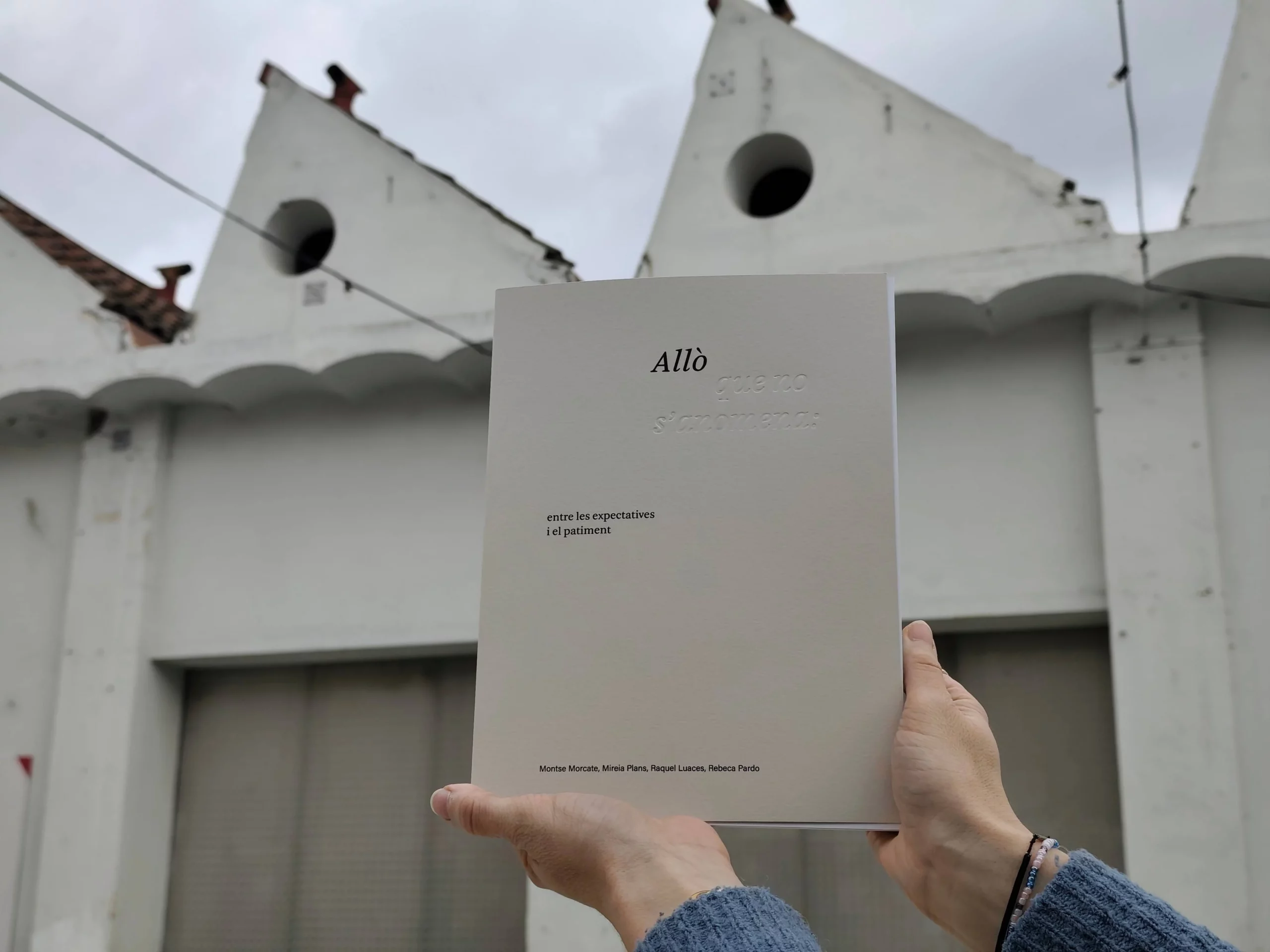
Exhibition Catalogue – Allò que no s’anomena: entre les expectatives i el patiment

Exhibition Catalogue – Allò que no s’anomena: entre les expectatives i el patiment

Roca Umbert Fàbrica de les Arts

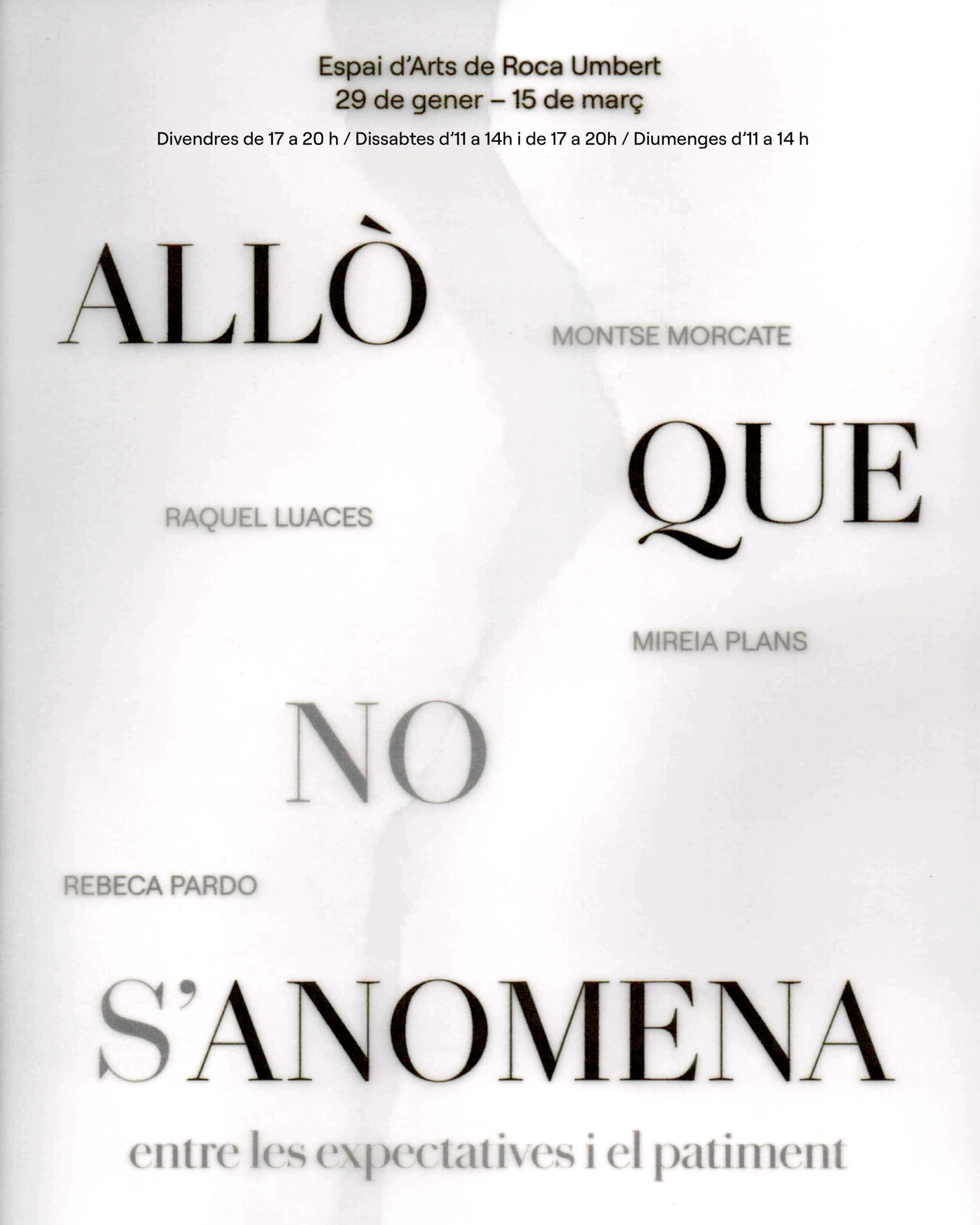
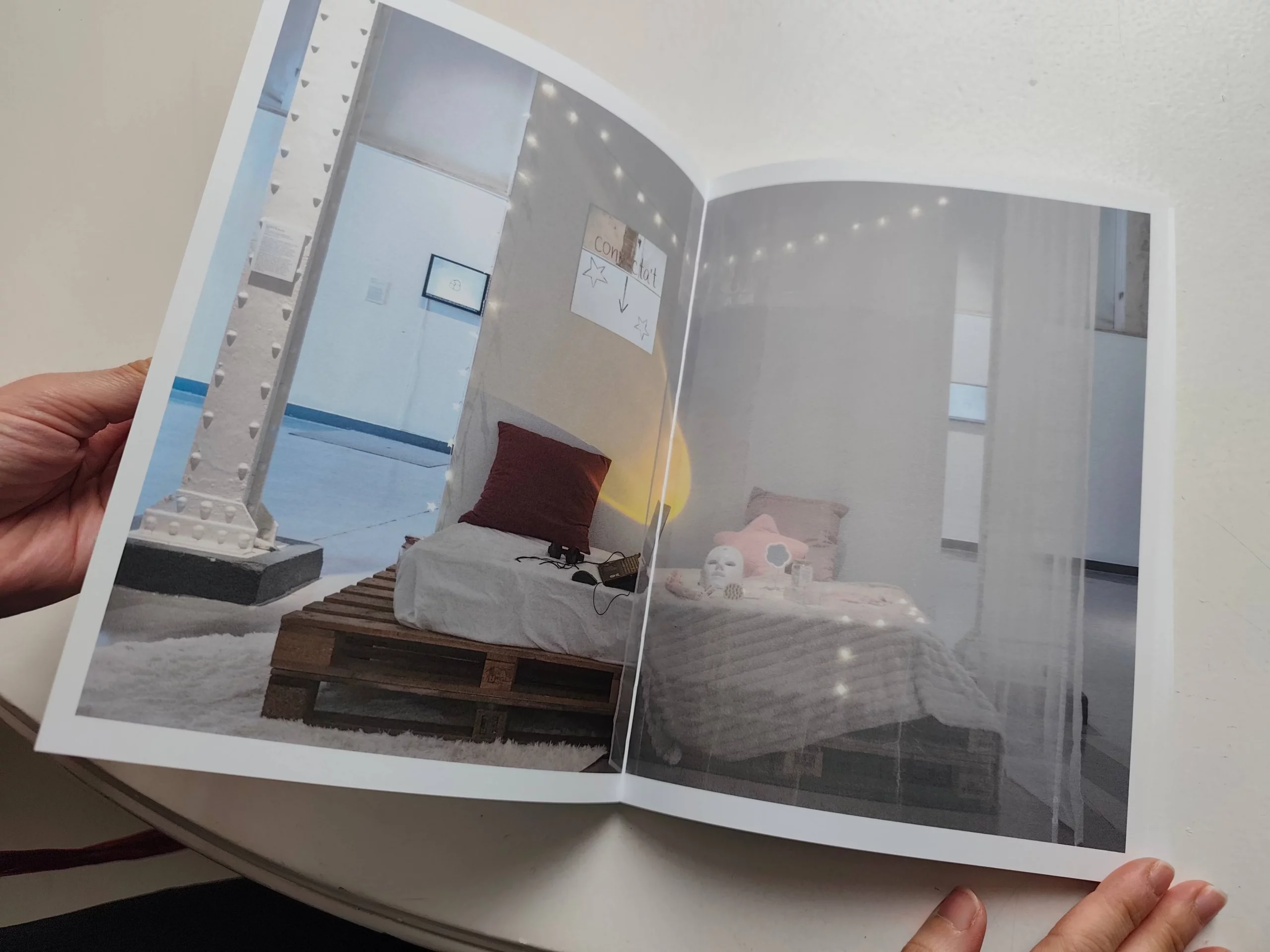
The catalogue Allò que no s’anomena: entre les expectatives i el patiment expands on the texts from the exhibition of the same name, written by independent curator Nerea Campo, and brings together visual documentation and new approaches to the works of Montse Morcate, Mireia Plans, Raquel Luaces and Rebeca Pardo, developed by the artists themselves.

The exhibition Allò que no s’anomena: entre les expectatives i el patiment was based on the idea that imposed social expectations sustain the system, often at the cost of silence and suffering. Historically, femininity has been associated with the obligation to please, not to disturb, and above all not to speak or point out the forms of violence that traverse bodies and lives. Naming, however, compels us to observe and confront uncomfortable realities. From practices as diverse as installation and the photobook, the artists addressed everyday yet structural forms of violence related to motherhood, mental health, aesthetic pressure, technology, and mechanisms of social recognition.

The exhibition could be seen at Espai d’Arts de Roca Umbert from January 29 to March 15, 2026.

The catalogue can be purchased at the information point of Roca Umbert Fàbrica de les Arts (Fridays from 5 to 8 pm; Saturdays from 10:30 am to 1:30 pm and from 5 to 8 pm; and Sundays from 10:30 am to 1:30 pm). It can also be bought through the online shop and collected at the information point during opening hours.

The catalogue and the exhibition, organized by Roca Umbert Fàbrica de les Arts with the support of the Departament de Cultura de la Generalitat de Catalunya, have been funded by the Ministerio de Ciencia, Innovación y Universidades, the European Union, and the Agencia Estatal de Investigación / PID2022-137176OA-I00.

Round Table

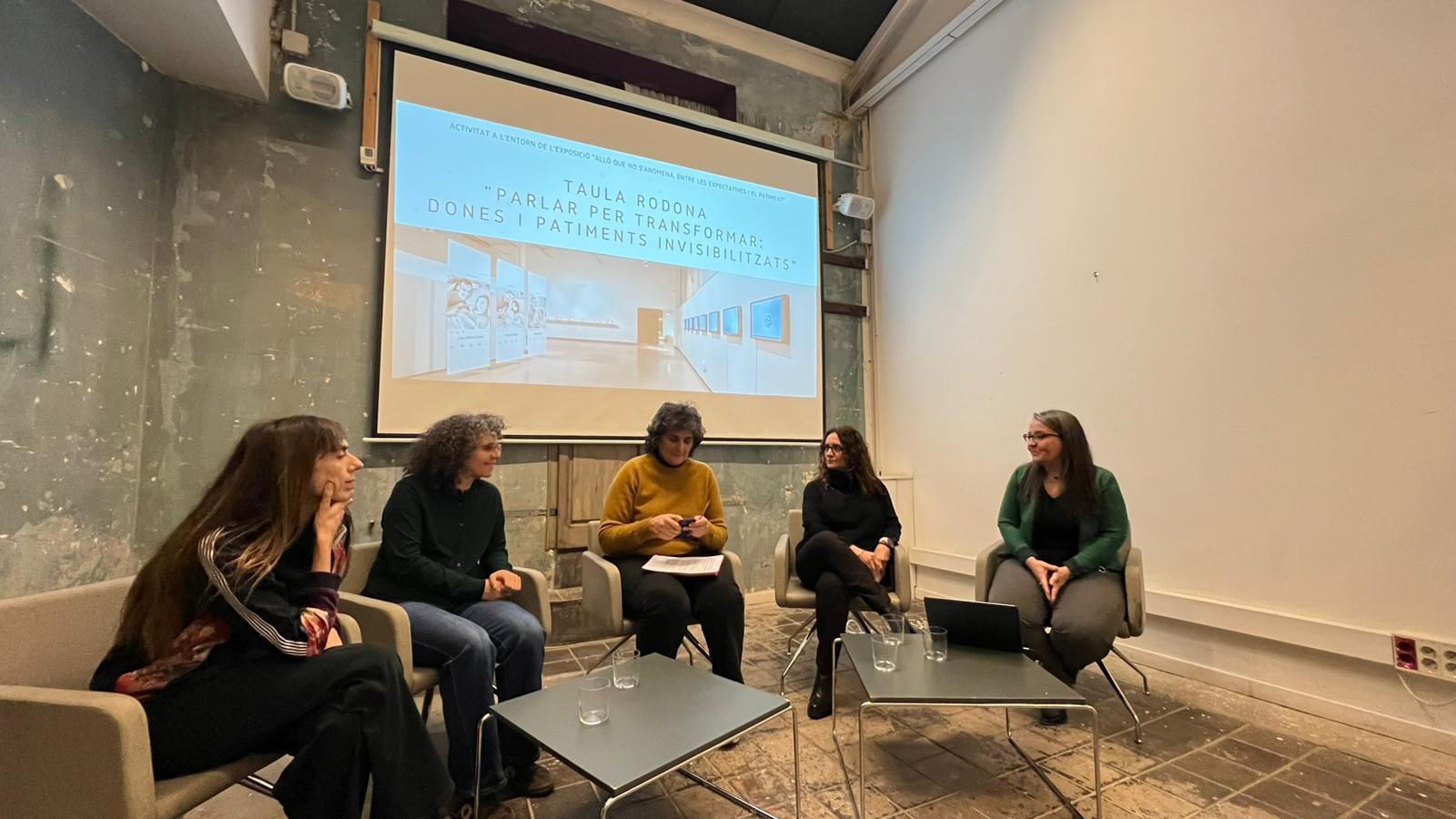
Round table – “Speaking to Transform: Women and Invisibilized Suffering”
Activity organized in the context of the exhibition Allò que no s’anomena. Entre les expectatives i el patiment

February 19 – Roca Umbert Fàbrica de les Arts

Within the framework of the exhibition Allò que no s’anomena. Entre les expectatives i el patiment, we open a space for dialogue and exchange between art and the fields of health sciences, care, and emotional support.

The conversation will bring together the artists Montse Morcate and Rebeca Pardo, featured in the exhibition with the works F.I.V and Baby is born, baby is here and A contrafil, respectively. These works address and reclaim forms of pain and suffering linked to fertility processes, obstetric violence, and gender biases in the identification of high abilities in women.

They will be joined by Mònica Cortés, a psychologist specialized in high abilities, and Susana Rodríguez, a midwife at Hospital del Mar, to explore how creative processes move beyond the boundaries of art and connect with professional practices. From diverse yet complementary perspectives, the discussion will address how art can generate knowledge, open up questions, and establish connections and synergies with other disciplines, while engaging with the ways in which often invisibilized experiences are constructed, lived, and narrated.

The activity invites the public to take part in a space for critical reflection and exchange, where diverse disciplines engage in dialogue to imagine new forms of support, understanding, and collective care.

EXHIBITION – That Which Is Not Named: Between Expectations and Suffering

That Which Is Not Named: Between Expectations and Suffering

Roca Umbert Fàbrica de les Arts

That Which Is Not Named: Between Expectations and Suffering stems from the idea that imposed social expectations uphold the system, often at the cost of silence and suffering. Historically, femininity has been associated with the obligation to please, not to disturb, and above all not to speak or point out the forms of violence that traverse bodies and lives. Naming, however, compels us to observe and confront uncomfortable realities.

The exhibition brings together work developed by the artists Montse Morcate, Mireia Plans, Raquel Luaces, and Rebeca Pardo, partly during their residency at Roca Umbert and within the framework of the academic research project Contemporary Representations of Grief and Suffering: Visibility, Agency and Social Transformation through the Image (Generación de Conocimiento 2022 – Ministry of Science and Innovation). Through diverse practices such as installation and the photobook, the artists address everyday yet structural forms of violence related to motherhood, mental health, aesthetic pressure, technology, and mechanisms of social recognition.

With the participation of Montse Morcate, Mireia Plans, Raquel Luaces, and Rebeca Pardo

Texts by Nerea Campo
Graphic design by Núria Vila
Organized and produced by Espai d’Arts, Roca Umbert Fàbrica de les Arts and the City Council of Granollers
With the support of the Department of Culture of the Generalitat de Catalunya
Funded by the Ministry of Science, Innovation and Universities, the European Union, and the State Research Agency / PID2022-137176OA-I00

Opening of the exhibition “That Which Is Not Named: Between Expectations and Suffering”
Exhibition by Montse Morcate, Raquel Luaces, Mireia Plans and Rebeca Pardo

Thu. 29.01.26 | 7:00 pm

Round table “Speaking to Transform: Women and Invisibilised Sufferings”
Activity related to the exhibition Thu. 19.02.26 | 7:00 pm

Guided tour of the exhibition
Led by the artists Sat. 28.02.26 | 12:00 pm

Presentation of the exhibition catalogue
With the artists and Nerea Campo Thu. 12.03.26 | 7:00 pm
Espai d’Arts

Family workshop Drip, splash, smear! Body and action painting to speak about what is not named Body and action painting to speak about what is not named Sat. 14.03.26 | 5:30 pm

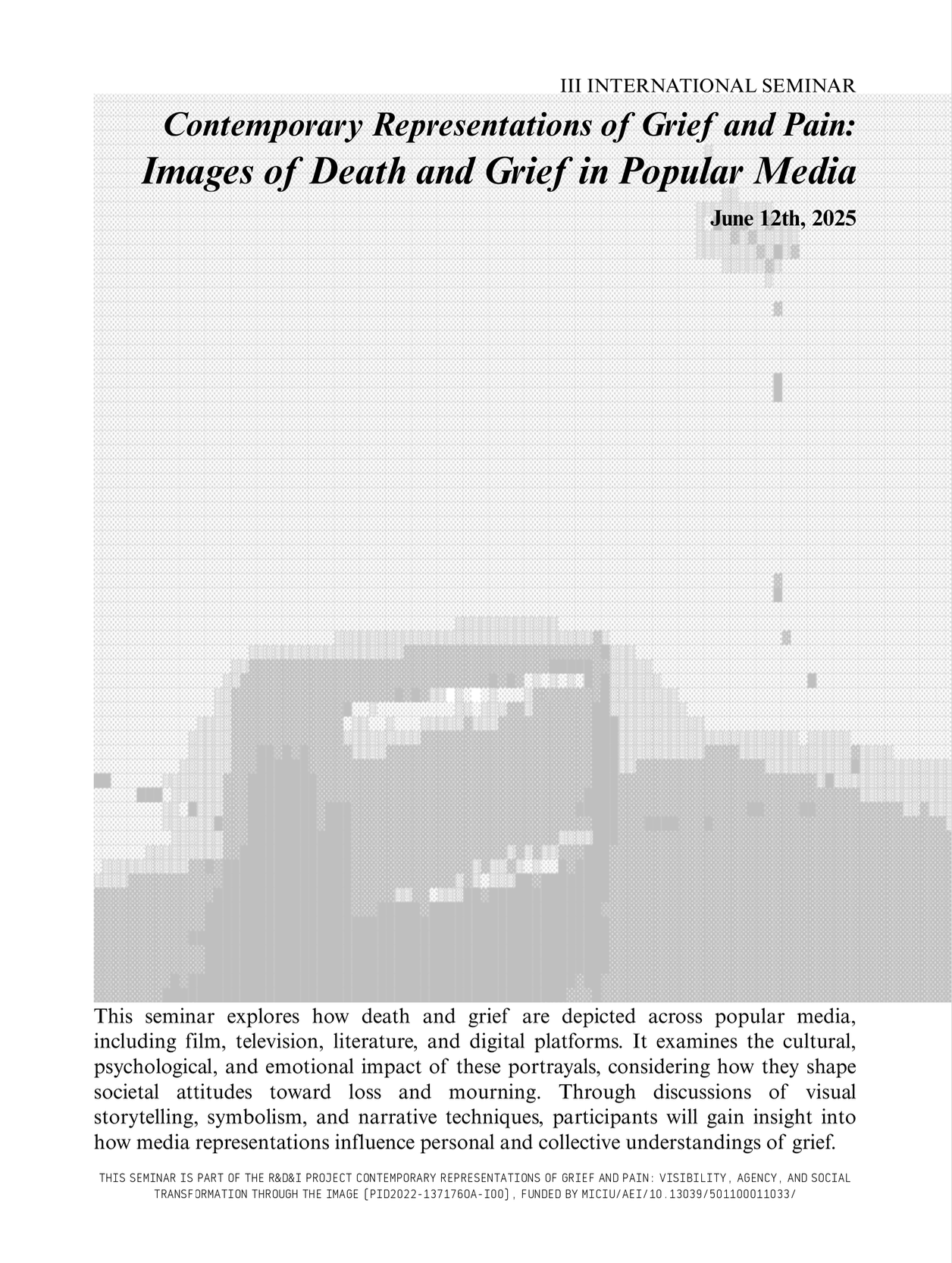
III INTERNATIONAL SEMINAR

III INTERNATIONAL SEMINAR

Images of Death and Grief in Popular Media
12 de Junio de 2025 a las 12H.
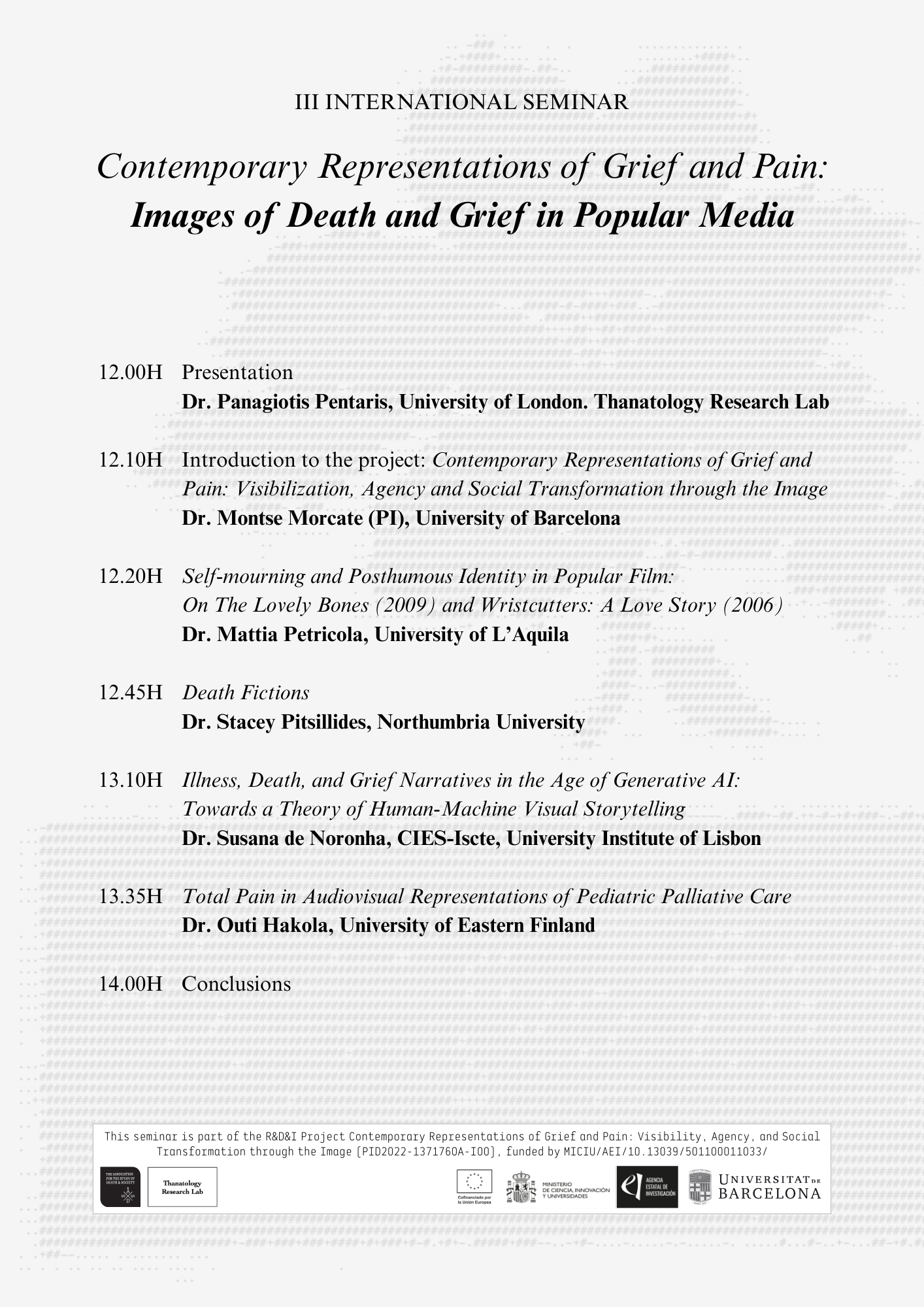
We are pleased to share the poster and the PDF with the full programme and abstracts.
PROGRAMME

12.00H Presentación de Panagiotis Pentaris. Thanatology Research Lab


12.15H Representaciones del Duelo y el Dolor: Visibilización, Agencia y Transformación Social a través de la Imagen. Introducción al proyecto por Montse Morcate, Investigadora Principal (IP)


12.30H Mattia Petricola. Self-mourning and Posthumous Identity in Popular Film: On The Lovely Bones (2009) and Wristcutters: A Love Story (2006)


12.50H Dr Stacey Pitsillides


13.10H Susana de Noronha


13.30H Outi Hakola. Total Pain in Audiovisual Representations of Pediatric Palliative Care


13.50H Conclusiones

ABSTRACTS

Presentation – Dr. Panagiotis Pentaris

Dr. Panagiotis Pentaris is an Associate Professor of Social Work & Thanatology, with international education and practice experience in disaster work and end of life care. Panagiotis is the Director of Research and Research Studies for the Department of Social,Therapeutic and Community Studies at Goldsmiths University of London, UK, where he is also acting as Deputy Head. His work has focused on death, dying, bereavement, religion, belief, gender and sexual diversity, and disaster social work. He is the founding leader of the Thanatology Research Lab at the University of London, and his research has explored aspects of death and dying in social science and social policy internationally.


Introduction to the project: Representations of grief and pain: visibilization, agency and social transformations through the image – Dr. Montse Morcate (PI)

The project deals with visual narratives and images related to processes of grief and pain with the aim of analyzing and detecting the processes of visibilization of certain people and groups that suffer from them and that are invisibilized or stigmatized. At the same time, the capacity for action and agency of these images is addressed, as well as their potential as mediators of the grieving process.

Dr. Montse Morcate is an artist, researcher and lecturer in the Faculty of Fine Arts at the University of Barcelona. Morcate’s research focuses on the visual representation of death, illness and grief, and she takes a multidisciplinary approach that encompasses contemporary art, visual anthropology, the medical humanities, the digital humanities, photojournalism and historical memory. Currently she is the PI of the research Project “Contemporary representations of grief and pain: visibilization, agency and social transformation through the image”. (Representaciones contemporáneas del duelo y el dolor: visibilizacion, agencia y transformación social a través de la imagen). Proyectos de Generación de Conocimiento 2022 (Ministerio de Ciencia, Innovación y Universidades) and the artistic residency “Matrix on fire: invisible narratives of grief, pain and violence” at Roca Umbert Fabrica de les Arts.


Self-mourning and Posthumous Identity in Popular Film: On The Lovely Bones (2009) and Wristcutters: A Love Story (2006) – Dr. Mattia Petricola

This talk examines representations of self-mourning and posthumous subjectivity in The Lovely Bones (2009) and Wristcutters: A Love Story (2006). In both films, protagonists die—or enter liminal states—and migrate to alternate planes of existence, where they gain the capacity to mourn their own deaths. These narratives challenge traditional frameworks of grief by positioning the dead as both mourners and mourned. Wristcutters ultimately permits a return to the living, suggesting that self-mourning can catalyze renewal. By contrast, The Lovely Bones culminates in a bittersweet closure: the heroine both witnesses and participates in the bereavement of the living, then relinquishes her ties to the material world. The talk explores how these films reimagine mourning, self-narration, and the afterlife.

Dr. Mattia Petricola is adjunct professor of literary theory and intermedial studies at the University of L’Aquila (Italy). His research on thanatology focuses on intermedial states between life and death, the representation of death in popular culture, and queer death studies. He co-authored, with Panagiotis Pentaris, chapters for the Bloomsbury Cultural History of Death and the forthcoming Routledge Queer Death Studies reader.


Death Fictions – Dra. Stacey Pitsillides
Fictions enable us, at a safe distance, to explore our relationship with the world. Design Fictions allow us to enter these worlds: letting people experience, touch and explore them (Galloway and Caudwell, 2018). At times to provoke (Dunne and Raby, 2013), at others to reassure (Coulton et al, 2017). Drawing from speculative feminist thinking (María Puig de la Bellacasa, 2017; Paxling, 2018) and posthuman imaginaries (Neimanis et al, 2015) this talk will use examples from film, literature and design practice to draw people into re-imagining death – to confront, unpack, rethink, or play with how death can be brought closer and mediated through a bio-technical lens into alternative futures.

Dr Stacey Pitsilides is an Associate Professor in the School of Design, Arts and Creative Industries at Northumbria University and co-lead of the Design Feminisms Research Group. Her research into death, creativity and technology, has been explored through a series of publications, and a body of practice, including the Death Positive Library: Love After Death. Collaborating with hospices, festivals, libraries and scientists, her practice research has been commissioned and installed during NESTA’s FutureFest, London Design Week, the ESRC Festival of Social Science and DesignTO festival, Toronto, among others. She is an honorary research fellow for the Centre for Death and Society (CDAS), University of Bath, an elected member for the Council of the Association for the Study of Death and Society (ASDS) and on the board of artistic directors for D6:EU, a cultural NGO based in Cyprus. Illness, Death, and Grief Narratives in the Age of Generative AI: Towards a Theory of Human-Machine Visual Storytelling


Illness, Death, and Grief Narratives in the Age of Generative Al: Towards a Theory of Human-Machine Visual Storytelling – Dra. Susana de Noronha

An evolving technology – artificial intelligence (AI) image generators – is engendering a new variant of illness narratives that calls into question previous assumptions about their connection to traditional forms of art and image-making. These technologies are not only reshaping how we represent and make sense of illness, but also how we represent death and grief. The social sciences must interrogate and analyze these shifts, developing a comprehensive theory of the embeddedness of AI-generated images in personal and collective experiences of illness, dying, mourning and remembrance. We must ask in what ways these images matter for a renewed relationship not only with out bodies, but with loss – in how we visualize vulnerability, mortality, and resilience, and how we narrate the emotional and existential dimensions of suffering, death, and grieving through human-machine collaboration.

Susana de Noronha is a Researcher at CIES-Iscte – Centre for Research and Studies in Sociology, University Institute of Lisbon (IUL), Portugal. Anthropologist and Sociologist (Ph.D.), she works at the intersection of Science and Technology Studies (STS), Anthropology of Art, and Material and Visual Culture Studies.


Total Pain in Audiovisual Representations of Pediatric Palliative Care – Dra. Outi Hakola

Documentary narratives about terminally ill children in pediatric palliative care construct affective and embodied representations of death and dying. The loss of a child is a profoundly tragic event, inflicting pain not only on the child but also on their family and medical caregivers. Adopting a phenomenological approach to pain, I apply Cicely Saunders’ concept of total pain to interpret audiovisual narratives such as the documentary television series The Hospice (2008) and Beautiful Lives (2011), as well as the documentary films Some Good Days (Davies, 1996), Griefwalker (Wilson, 2008), and Dying in Your Mother’s Arms (Beder, 2020). I argue that the subtle yet emotionally overwhelming portrayal of dying children extends the experience of grief and suffering to the viewer, rendering total pain a shared, affective experience. Instead of presenting fixed moral judgments, these narratives invite viewers to feel, reflect, and create an emotional connection to suffering in a way that makes these deaths visible and meaningful in contemporary society.

Dr. Outi Hakola is a lecturer in the Department of Health and Social Management at the University of Eastern Finland. Her background is in film studies, and her research concentrates on questions of death, dying, and health in audiovisual culture. Her most recent book Filming Death: End-of-Life Documentary Cinema was published by Edinburgh University Press in 2024.


This seminar forms part of the R&D&I project Contemporary Representations of Grief and Pain: Visibility, Agency and Social Transformation through the Image (PID2022-137176OA-I00), funded by MICIU/AEI/10.13039/501100011033 and FEDER.

II INTERNATIONAL SEMINAR

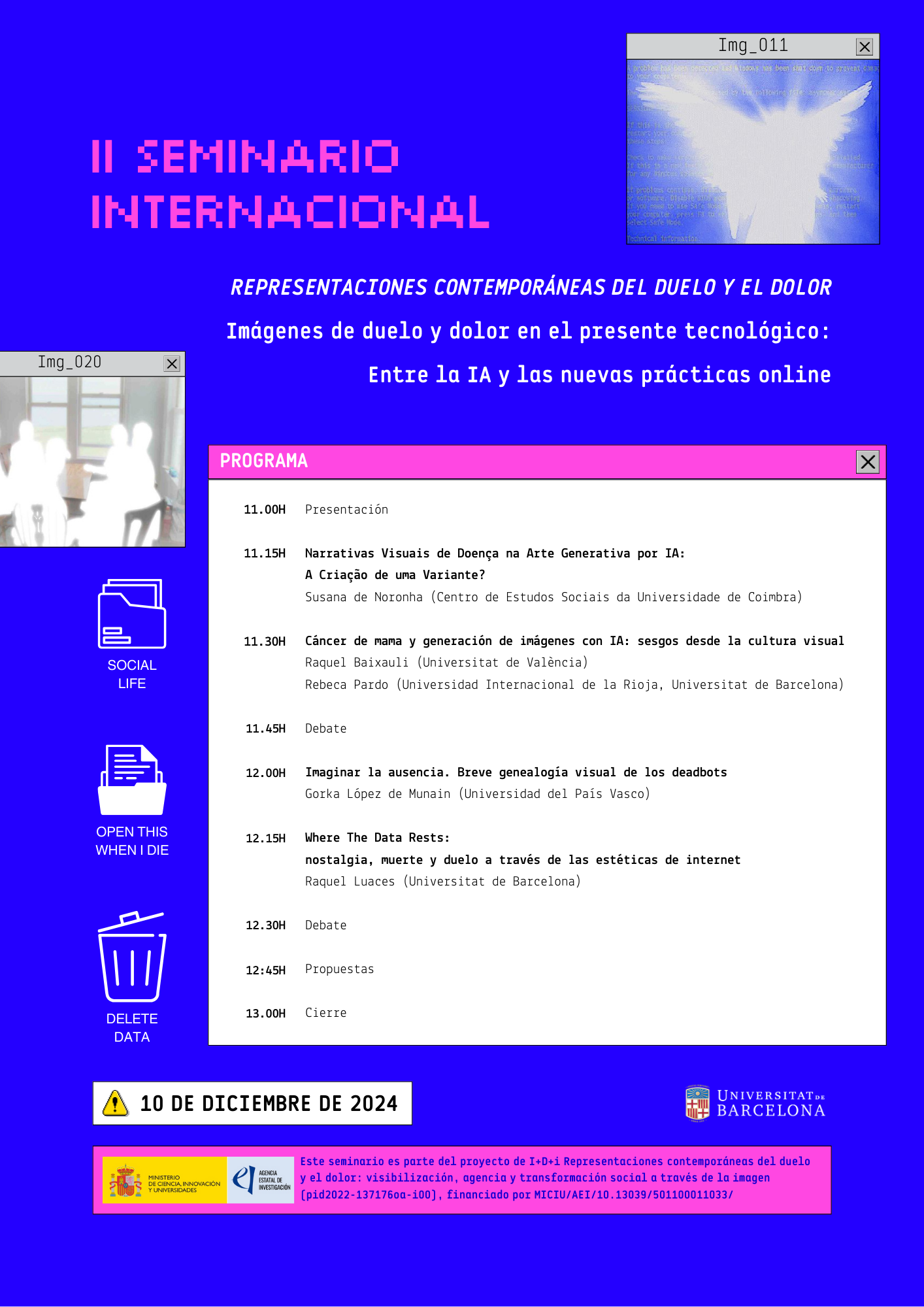
II INTERNATIONAL SEMINAR CONTEMPORARY REPRESENTATIONS OF GRIEF AND PAIN

Images of Grief and Pain in the Technological Present: Between AI and New Online Practices
Tuesday, December 10, 2024, at 11:00 am
We are pleased to share the poster and the PDF with the full programme and abstracts.
PROGRAMME
11:00 am Presentation
11:15 am Narrativas Visuais de Doença na Arte Generativa por IA: A Criação de uma Variante?
Susana de Noronha (Centre for Social Studies, University of Coimbra)
11:30 am Breast Cancer and AI Image Generation: Biases from Visual Culture
Raquel Baixauli (Universitat de València)
Rebeca Pardo (Universidad Internacional de la Rioja, Universitat de Barcelona)
11:45 am Discussion
12:00 pm Imagining Absence. A Brief Visual Genealogy of Deadbots
Gorka López de Munain (University of the Basque Country)
12:15 pm Where the Data Rests: Nostalgia, Death and Grief through Internet Aesthetics
Raquel Luaces (Universitat de Barcelona)
12:30 pm Discussion
12:45 pm Proposals
1:00 pm Closing


ABSTRACTS

Visual Narratives of Illness in AI Generative Art: The Creation of a Variant?

Susana de Noronha (Centre for Social Studies, University of Coimbra)

An evolving technology—artificial intelligence image generators—is giving rise to a new variant of visual narratives of illness that calls into question claims previously made about earlier art forms. This paper examines the transformations brought about by this technology, with the aim of developing a comprehensive theory about the embedding of generative visual “art” (via AI) within experiences and narratives of illness, and vice versa. How might AI-generated images and art reshape our relationship not only with our bodies but also with the world around us, in the ways we experience and represent illness?

Combining medical anthropology with social studies of science, technology, art, and material culture, this presentation proposes a comparative and inclusive analysis covering all types of illness (mental, organic, and disabilities) as well as all stages, from chronic or in remission to advanced or terminal. Theoretically and methodologically, it prioritizes the voice and creative agency of patients, grounded in their situated knowledge, with the aim of rethinking the entanglements of illness, resistance, art, and technology.

Breast Cancer and AI Image Generation: Biases from Visual Culture

Raquel Baixauli (Universitat de València)

Rebeca Pardo (Universidad Internacional de la Rioja, Universitat de Barcelona)

This ongoing research focuses on representations of breast cancer generated by artificial intelligence. From the prompts used to produce images, the use of seemingly objective terms such as “woman with breast cancer” often triggers AI responses warning that community guidelines are being violated. However, the system does generate images when additional related terms are introduced, for example those linked to war metaphors surrounding illness.

Our aim is to analyse these biases from the perspectives of visual culture and art history. From this standpoint, the resulting images—frequently idealised or sugar-coated—appear more closely related to stock image banks and advertising imaginaries surrounding illness (including pinkwashing) than to artistic or photojournalistic projects addressing the subject.

Imagining Absence. A Brief Visual Genealogy of Deadbots

Gorka López de Munain (Universidad del País Vasco)

In recent months, numerous news stories have emerged about new “deadbot” models, generating significant controversy. These are digital replicas with which it is possible to interact fluidly through text or animated image-based conversation. The purpose of this intervention is not primarily to assess the appropriateness of such applications or question their role in processes of grief—essential aspects that must indeed be addressed—but rather to explore their precedents in earlier historical moments. Through a series of examples, it becomes evident that the relationship with images of the deceased has always been fluid and intense, pushing the limits of each era’s media technologies. This genealogy seeks to contextualise these striking “deadbots,” moving beyond headlines that reduce them to mere curiosities of digital society.

WHERE THE DATA RESTS: Nostalgia, Death and Grief through Internet Aesthetics

Raquel Luaces (Universitat de Barcelona)

Within the framework of my doctoral research on virtual liminal spaces and images belonging to “internet aesthetics” related to death and grief—created and shared online by users in recent years—I have developed an artistic project in the form of an experimental video game. This 3D space invites users to interact within a virtual environment that merges the familiar with the uncanny. Players encounter AI-generated messages integrated into the liminal atmosphere, evoking the nostalgia of 1990s chatbots and games such as Akinator. In this context, AI becomes a kind of digital medium, guiding participants through themes of nostalgia and loss while gradually delving into each user’s personal experience.


This seminar forms part of the R&D&I project *Contemporary Representations of Grief and Pain: Visibility, Agency and Social Transformation through the Image* (PID2022-137176OA-I00), funded by MICIU/AEI/10.13039/501100011033 and FEDER.
I INTERNATIONAL SEMINAR: IMAGES OF HEALTH AND GENDER

I INTERNATIONAL SEMINAR: CONTEMPORARY REPRESENTATIONS OF GRIEF AND PAIN

IMAGES OF HEALTH AND GENDER
Tuesday, July 9, 2024, from 12:00 to 2:00 pm
We are pleased to share the poster with the programme.
PROGRAMME
11:00 am Presentation
11:15 am Representations of Childbirth in Medical TV Series: Pain and Healthcare
Irene Cambra Badii (Universitat de Vic)
Paula Paragis (Universidad de Buenos Aires)
11:30 am The Bedroom as a Stage for Grief
Laura Bravo (Universidad de Puerto Rico)
11:45 am Sensitive Material
Mireia Plans (Universitat de Barcelona)
12:00 pm “With What You Have, Do What You Can” The Experience of Nurses During the Covid-19 Pandemic in Barcelona and Their Photographic Production
Amanda Bernal (Universitat de Barcelona)
12:15 pm Obstetric Violence: A Reflection on the Absence of Images
Montse Morcate (Universitat de Barcelona)
12:30 pm Discussion and exchange of proposals
1:00 pm Closing

This seminar forms part of the R&D&I project *Contemporary Representations of Grief and Pain: Visibility, Agency and Social Transformation through the Image* (PID2022-137176OA-I00), funded by MICIU/AEI/10.13039/501100011033 and FEDER.