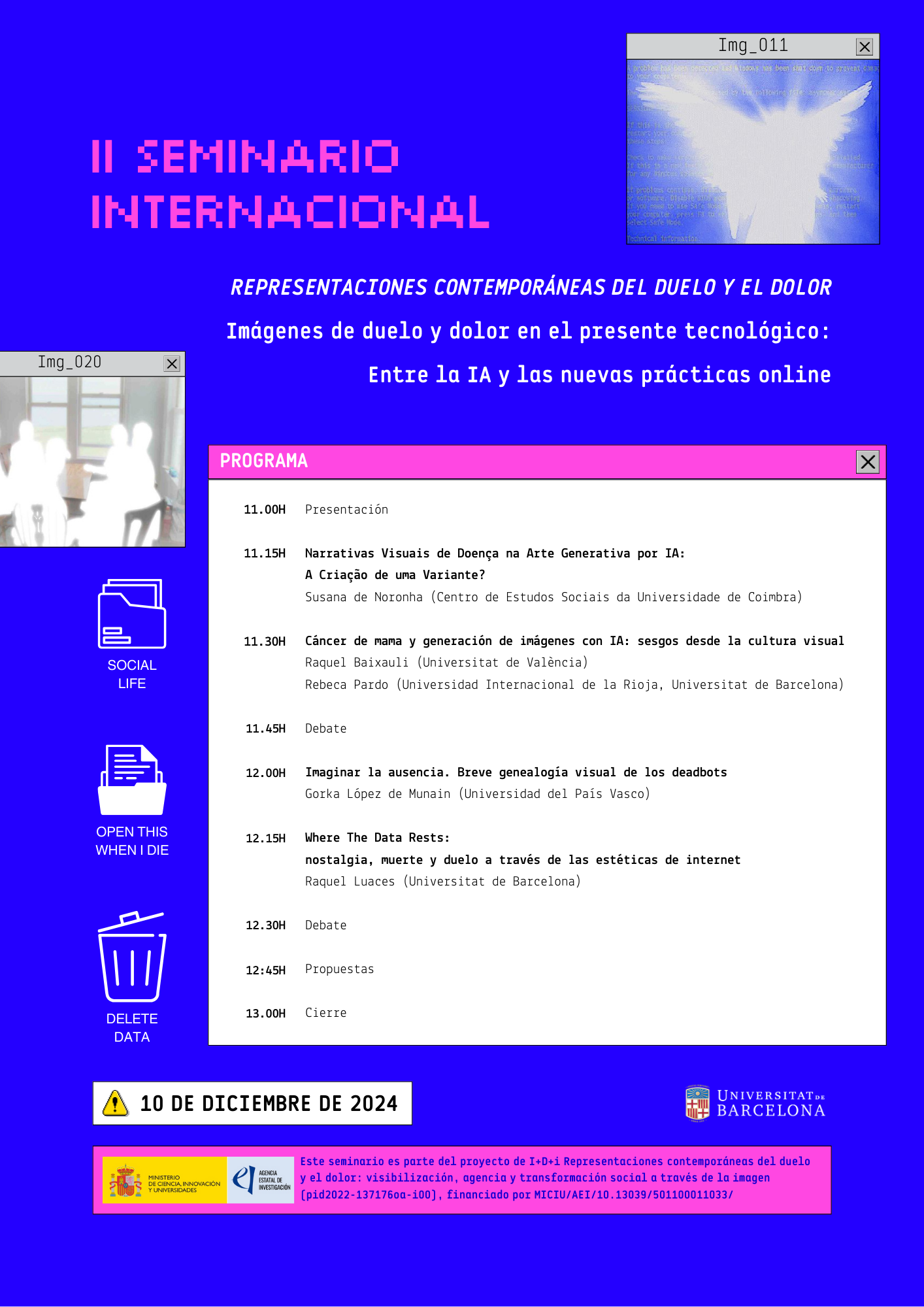
II INTERNATIONAL SEMINAR CONTEMPORARY REPRESENTATIONS OF GRIEF AND PAIN
Images of Grief and Pain in the Technological Present: Between AI and New Online Practices
Tuesday, December 10, 2024, at 11:00 am
We are pleased to share the poster and the PDF with the full programme and abstracts.
PROGRAMME
11:00 am Presentation
11:15 am Narrativas Visuais de Doença na Arte Generativa por IA: A Criação de uma Variante?
Susana de Noronha (Centre for Social Studies, University of Coimbra)
11:30 am Breast Cancer and AI Image Generation: Biases from Visual Culture
Raquel Baixauli (Universitat de València)
Rebeca Pardo (Universidad Internacional de la Rioja, Universitat de Barcelona)
11:45 am Discussion
12:00 pm Imagining Absence. A Brief Visual Genealogy of Deadbots
Gorka López de Munain (University of the Basque Country)
12:15 pm Where the Data Rests: Nostalgia, Death and Grief through Internet Aesthetics
Raquel Luaces (Universitat de Barcelona)
12:30 pm Discussion
12:45 pm Proposals
1:00 pm Closing
ABSTRACTS
Visual Narratives of Illness in AI Generative Art: The Creation of a Variant?
Susana de Noronha (Centre for Social Studies, University of Coimbra)
An evolving technology—artificial intelligence image generators—is giving rise to a new variant of visual narratives of illness that calls into question claims previously made about earlier art forms. This paper examines the transformations brought about by this technology, with the aim of developing a comprehensive theory about the embedding of generative visual “art” (via AI) within experiences and narratives of illness, and vice versa. How might AI-generated images and art reshape our relationship not only with our bodies but also with the world around us, in the ways we experience and represent illness?
Combining medical anthropology with social studies of science, technology, art, and material culture, this presentation proposes a comparative and inclusive analysis covering all types of illness (mental, organic, and disabilities) as well as all stages, from chronic or in remission to advanced or terminal. Theoretically and methodologically, it prioritizes the voice and creative agency of patients, grounded in their situated knowledge, with the aim of rethinking the entanglements of illness, resistance, art, and technology.
Breast Cancer and AI Image Generation: Biases from Visual Culture
Raquel Baixauli (Universitat de València)
Rebeca Pardo (Universidad Internacional de la Rioja, Universitat de Barcelona)
This ongoing research focuses on representations of breast cancer generated by artificial intelligence. From the prompts used to produce images, the use of seemingly objective terms such as “woman with breast cancer” often triggers AI responses warning that community guidelines are being violated. However, the system does generate images when additional related terms are introduced, for example those linked to war metaphors surrounding illness.
Our aim is to analyse these biases from the perspectives of visual culture and art history. From this standpoint, the resulting images—frequently idealised or sugar-coated—appear more closely related to stock image banks and advertising imaginaries surrounding illness (including pinkwashing) than to artistic or photojournalistic projects addressing the subject.
Imagining Absence. A Brief Visual Genealogy of Deadbots
Gorka López de Munain (Universidad del País Vasco)
In recent months, numerous news stories have emerged about new “deadbot” models, generating significant controversy. These are digital replicas with which it is possible to interact fluidly through text or animated image-based conversation. The purpose of this intervention is not primarily to assess the appropriateness of such applications or question their role in processes of grief—essential aspects that must indeed be addressed—but rather to explore their precedents in earlier historical moments. Through a series of examples, it becomes evident that the relationship with images of the deceased has always been fluid and intense, pushing the limits of each era’s media technologies. This genealogy seeks to contextualise these striking “deadbots,” moving beyond headlines that reduce them to mere curiosities of digital society.
WHERE THE DATA RESTS: Nostalgia, Death and Grief through Internet Aesthetics
Raquel Luaces (Universitat de Barcelona)
Within the framework of my doctoral research on virtual liminal spaces and images belonging to “internet aesthetics” related to death and grief—created and shared online by users in recent years—I have developed an artistic project in the form of an experimental video game. This 3D space invites users to interact within a virtual environment that merges the familiar with the uncanny. Players encounter AI-generated messages integrated into the liminal atmosphere, evoking the nostalgia of 1990s chatbots and games such as Akinator. In this context, AI becomes a kind of digital medium, guiding participants through themes of nostalgia and loss while gradually delving into each user’s personal experience.
This seminar forms part of the R&D&I project *Contemporary Representations of Grief and Pain: Visibility, Agency and Social Transformation through the Image* (PID2022-137176OA-I00), funded by MICIU/AEI/10.13039/501100011033 and FEDER.